
English
Hindi
Morbi's Ceramic Industry: Adopting Technology on the Journey from Volume to Value
Written byIndian Ceramic News
Share
Morbi, August 22, 2026 — Even as it navigates a gas crisis and a sharp fall in exports, Morbi's ceramic industry continues to strengthen its position through technology adoption. With an estimated 1,000-1,200 ceramic manufacturing units, Morbi today stands as the world's second-largest ceramic tile manufacturing cluster, accounting for nearly 70% of India's total ceramic production and close to 90% of the country's ceramic exports.
Why Technology Became Essential
International buyers once placed orders primarily on the basis of price. Over the last decade, that picture has changed — overseas buyers now prioritise production consistency, design variety, quality assurance, and long-term reliability. In response, Morbi's manufacturers have introduced automation, digital printing, advanced kiln systems, and precision quality-control processes into their factories, shifting focus away from simply producing more at a lower price and toward producing more valuable, more durable products.
Digital Printing Has Transformed Design
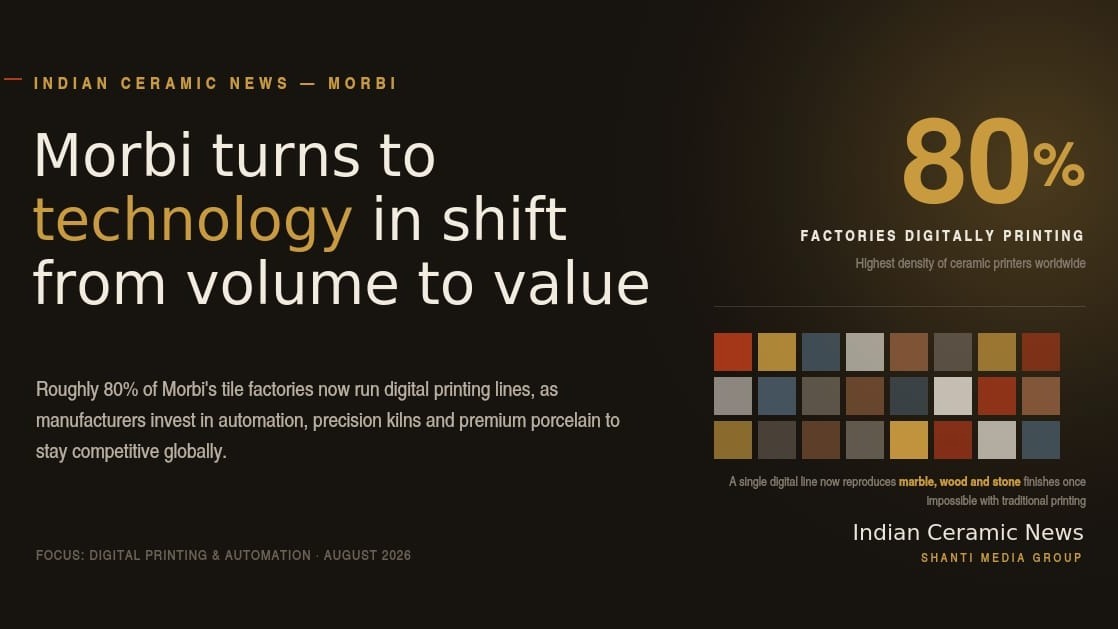
Roughly 80% of Morbi's tile factories now operate digital printing machines. This technology has made it possible to replicate an almost unlimited range of designs and textures, from marble to wood to stone, on a single tile, something traditional printing methods could never achieve. This has helped make Morbi the city with the highest concentration of ceramic printing machines anywhere in the world, and polished, digitally-printed tiles have become the cluster's most heavily exported product category.
Automation Paired With Energy-Saving Efforts
Frequently fluctuating gas prices have pushed manufacturers to focus more sharply on energy efficiency. Newer factories are increasingly moving toward automated, digitised pressing technology for porcelain surfaces in order to meet international quality standards. Alongside this, several units have begun investing in dedicated water-recycling systems and energy-saving processes, aiming to reduce production costs while also lowering their environmental footprint.
A Shift Toward the Premium Segment
A number of Morbi companies are now investing in product development, modern surface design, and international quality certifications in order to establish a presence in the premium porcelain tile segment. Large modern units producing thousands of square metres of porcelain tile daily are increasingly entering high-value markets beyond residential use, including commercial, hospitality, and infrastructure projects.
Adapting Despite Ongoing Challenges
Despite persistent challenges, including rising freight costs, fluctuating raw material prices, and volatility in the energy market, Morbi's manufacturers have continued to focus on improving operational efficiency, streamlining supply chains, and investing in new production technology. This adaptability has played a key role in maintaining the confidence of international buyers.
What Comes Next
Morbi's journey is not limited to the tile industry alone — it reflects a broader shift underway across Indian manufacturing: from low-cost volume toward higher value, and from purely local sales toward international partnerships. According to those close to the industry, the next phase will be defined not just by expanding production capacity, but by resilience, innovation, and sustained trust in global markets.
Indian Ceramic News will continue to track technology adoption efforts within Morbi's ceramic cluster.